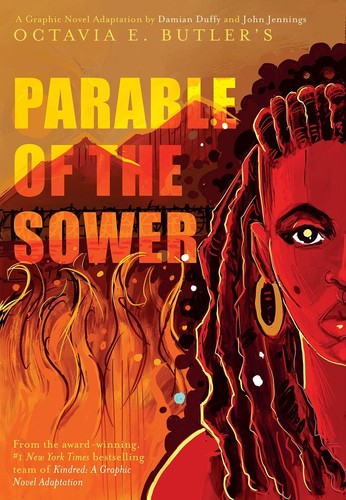
In 2025, with the world descending into madness and anarchy, one woman begins a fateful journey toward a better future.
Lauren Olamina and her family live in one of the only safe neighborhoods remaining on the outskirts of Los Angeles. Behind the walls of their defended enclave, Lauren’s father, a preacher, and a handful of other citizens try to salvage what remains of a culture that has been destroyed by drugs, disease, war, and chronic water shortages. While her father tries to lead people on the righteous path, Lauren struggles with hyperempathy, a condition that makes her extraordinarily sensitive to the pain of others.
When fire destroys their compound, Lauren’s family is killed and she is forced out into a world that is fraught with danger. With a handful of other refugees, Lauren must make her way north to safety, along the way conceiving a revolutionary idea that …
In 2025, with the world descending into madness and anarchy, one woman begins a fateful journey toward a better future.
Lauren Olamina and her family live in one of the only safe neighborhoods remaining on the outskirts of Los Angeles. Behind the walls of their defended enclave, Lauren’s father, a preacher, and a handful of other citizens try to salvage what remains of a culture that has been destroyed by drugs, disease, war, and chronic water shortages. While her father tries to lead people on the righteous path, Lauren struggles with hyperempathy, a condition that makes her extraordinarily sensitive to the pain of others.
When fire destroys their compound, Lauren’s family is killed and she is forced out into a world that is fraught with danger. With a handful of other refugees, Lauren must make her way north to safety, along the way conceiving a revolutionary idea that may mean salvation for all mankind.
Parable of the Sower was published in 1993, and takes place in 2024. The dystopian world Butler paints in this book is so close to our current reality it’s eerie .
El libro me ha enganchado, está muy bien escrito y plantea un futuro distópico interesante, producido por el cambio climático. Es sorprendente que se publicase a principios de los 90, porque es muy clarividente. Mi pero es porque la autora quiere que comulguemos con la parte espiritual, con la religion new age que plantea en el libro. He de reconocer que eso me ha sacado bastante de la lectura. Lo que sí que tengo claro es que leeré el siguiente y que seguro que lamento que la autora no pudiese escribir el final de la trilogía.
El libro me ha enganchado, está muy bien escrito y plantea un futuro distópico interesante, producido por el cambio climático. Es sorprendente que se publicase a principios de los 90, porque es muy clarividente.
Mi pero es porque la autora quiere que comulguemos con la parte espiritual, con la religion new age que plantea en el libro. He de reconocer que eso me ha sacado bastante de la lectura.
Lo que sí que tengo claro es que leeré el siguiente y que seguro que lamento que la autora no pudiese escribir el final de la trilogía.
It's certainly not a fun book, but it's extremely engaging, despite the bleakness of the slow-apocalypse setting and story.
What makes this apocalypse so horrifying, and the story so engaging, is how matter-of-fact Lauren is in describing everything in her diary. It's the world she grew up in, so it's normal to her, though she can see clearly even at 14 that it's unsustainable. There's a sharp generational divide between those who remember what things were like before, but all that is just history to her.
Lauren's present is hopeless and brutal, but her diary doesn't linger on the ever-present brutality like a horror novel would. She acknowledges it, of course, but she's focused on how to survive it so she can build something better.
The setting resonates so well today in part because the societal fears of the 1980s that Butler was extrapolating from are the …
It's certainly not a fun book, but it's extremely engaging, despite the bleakness of the slow-apocalypse setting and story.
What makes this apocalypse so horrifying, and the story so engaging, is how matter-of-fact Lauren is in describing everything in her diary. It's the world she grew up in, so it's normal to her, though she can see clearly even at 14 that it's unsustainable. There's a sharp generational divide between those who remember what things were like before, but all that is just history to her.
Lauren's present is hopeless and brutal, but her diary doesn't linger on the ever-present brutality like a horror novel would. She acknowledges it, of course, but she's focused on how to survive it so she can build something better.
The setting resonates so well today in part because the societal fears of the 1980s that Butler was extrapolating from are the same fears that have been re-stoked to create our modern political moment, and the problems she focused on remain unsolved. (I go into a bit more literary analysis on my website if you're interested in that sort of thing.)
This is such a strong story and great storytelling. I frequently found myself inspired by it to reflect on how we as individuals and communities may cope with our world. Can wholeheartedly recommend!
#FediBooks#Solarpunk
This is such a strong story and great storytelling. I frequently found myself inspired by it to reflect on how we as individuals and communities may cope with our world.
Can wholeheartedly recommend!
#FediBooks#Solarpunk
Hace tiempo que leí Xenogénesis, pero de lo poco que recordaba de ella era cómo la autora nos conducía, de la mano de un punto de vista, a la comprensión de fenómenos totalmente ajenos.
Aquí no es precisamente la ajenidad lo que nos atañe, sino un posible futuro nada impensable. Pero nuevamente, el punto de vista de la protagonista nos lleva de la mano y nos explica un futuro casi apocalíptico, con desgracias y miseria constantes, pero siempre, siempre, con esperanza.
Great vision of where we could easily find ourselves in the year 2024. Though things haven't (yet) turned out as bad as envisioned in the book, it definitely hits close to home. Was nice to read a pre-post apocalyptic (what to you call it when the apocalypse is ongoing?? Just apocalyptic?) novel that didn't have zombies everywhere. I enjoyed the elements of religion and thinking about how one would start a new religion that wasn't as laden with hundreds of years of doctrine and dogma as what we have now.
Great vision of where we could easily find ourselves in the year 2024. Though things haven't (yet) turned out as bad as envisioned in the book, it definitely hits close to home. Was nice to read a pre-post apocalyptic (what to you call it when the apocalypse is ongoing?? Just apocalyptic?) novel that didn't have zombies everywhere. I enjoyed the elements of religion and thinking about how one would start a new religion that wasn't as laden with hundreds of years of doctrine and dogma as what we have now.
Cuando estaba más joven la ficción y la ciencia ficción eran espacios que me hacían sentido para conectar con la imaginación y con la posibilidad de pensar y sentir la vida fuera de límites que percibía en mis presentes.
Como estos ámbitos de la literatura no resonaban tanto en algunas de mis redes cercanas, me alejé un poquito de éstos por algunos años y me metí a libros más teóricos y "serios". Pero desde que empecé a leer a Octavia Butler, por recomendación de una amiga, volví a interesarme en textos de (ciencia) ficción.
Octavia reflexionó sobre la ausencia/invisibilización de mujeres negras en un contexto donde predominaba una ciencia ficción de escritores hombres y blancos. También propuso escenarios que abordaran los pasados-presentes-futuros y que estimularan la imaginación y la creatividad como posibilidades ante las crisis que seguimos viviendo.
En Parable of the sower, Octavia tejió temas como: …
Cuando estaba más joven la ficción y la ciencia ficción eran espacios que me hacían sentido para conectar con la imaginación y con la posibilidad de pensar y sentir la vida fuera de límites que percibía en mis presentes.
Como estos ámbitos de la literatura no resonaban tanto en algunas de mis redes cercanas, me alejé un poquito de éstos por algunos años y me metí a libros más teóricos y "serios". Pero desde que empecé a leer a Octavia Butler, por recomendación de una amiga, volví a interesarme en textos de (ciencia) ficción.
Octavia reflexionó sobre la ausencia/invisibilización de mujeres negras en un contexto donde predominaba una ciencia ficción de escritores hombres y blancos. También propuso escenarios que abordaran los pasados-presentes-futuros y que estimularan la imaginación y la creatividad como posibilidades ante las crisis que seguimos viviendo.
En Parable of the sower, Octavia tejió temas como: sensibilidad hacia otrxs seres; críticas al capitalismo, a las desigualdades socio-económicas, a la explotación y hacia la crisis climática; formas de construir relaciones y comunidades basadas en el reconocimiento mutuo; cercanías y comprensiones diversas con la tierra y la sostenibilidad de la vida (entre muchas otras cosillas).
Algo que me parece muy curioso, es la manera en que Octavia toma aspectos del libro, que como lectora me estuvieron haciendo cierto ruido de forma muy sutil, y los hace evidentes en la secuela (Parable of the talents). Creo que no es sencillo plantear todo un imaginario y luego construir una narrativa que lo replantee o que muestre sus matices, al menos de forma convincente. Por eso, aunque Parable of the sower es un libro que aprecié haber leído, verlo de la mano con Parable of the talents fue aún más apreciable para mí.
The government is useless and we're all gonna get raped and our houses burned down
4 stars
Both right-wing and left-wing preppers will find something for them in this book. Written from the POV of a teenager in a life-or-death situation, the book is pretty much on survival mode the entire time, with the accompanying lack of nuance and fear permeating throughout. Still, seems like an important and balanced read.
On a second read, I feel a lot differently than I did the first time around. I can't separate uncomfortable feelings of reading about a teenager basically starting a cult and attracting people who are at their absolute most vulnerable to join. It doesn't sit well with me to read about Lauren's glee to "raise babies in Earthseed." And the intense, intense, dehumanization and otherizing of people using drugs, making them into physically unrecognizable monsters, is something I can't get past. If Lauren has hyper-empathy, and is more sensitive to people in need of help, then why does the buck stop with people using drugs?
On a second read, I feel a lot differently than I did the first time around. I can't separate uncomfortable feelings of reading about a teenager basically starting a cult and attracting people who are at their absolute most vulnerable to join. It doesn't sit well with me to read about Lauren's glee to "raise babies in Earthseed." And the intense, intense, dehumanization and otherizing of people using drugs, making them into physically unrecognizable monsters, is something I can't get past. If Lauren has hyper-empathy, and is more sensitive to people in need of help, then why does the buck stop with people using drugs?